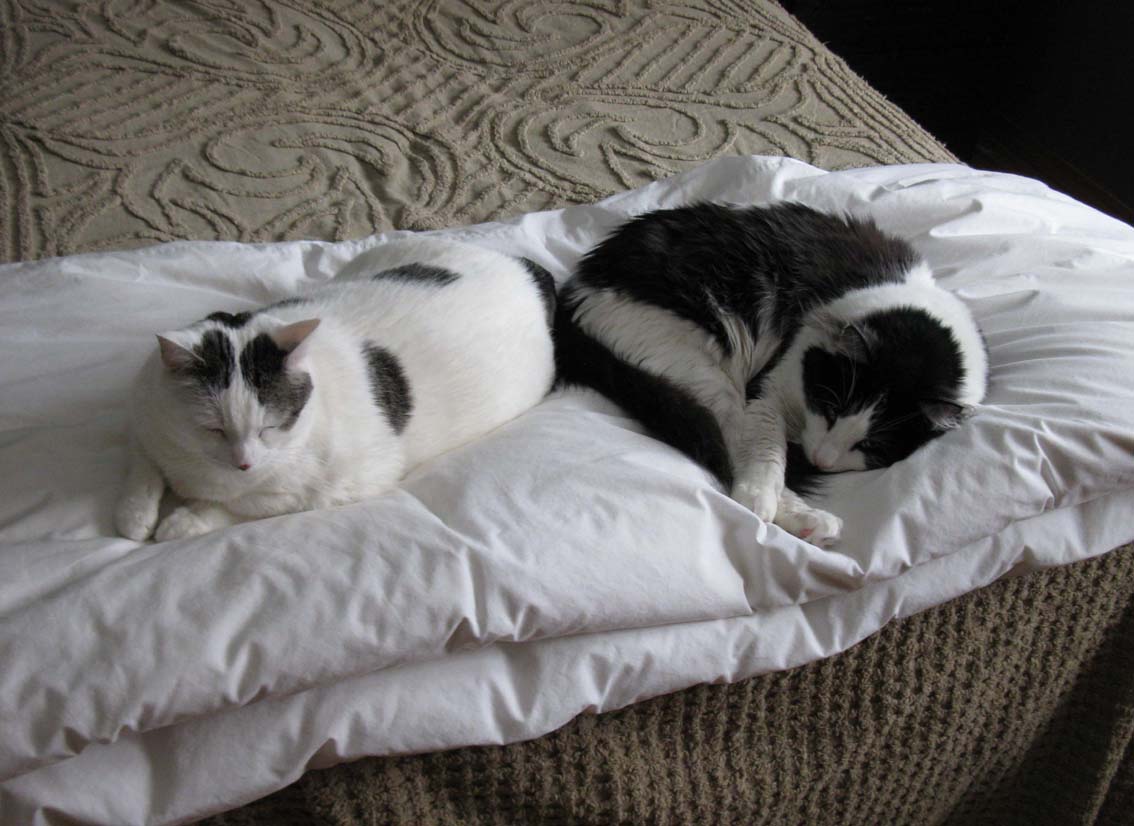
I may have written before about how my cats play, but it, like so much else about them, evolves, so I thought I’d put down how each likes to play now. That way I can compare it to later, when each has become jaded with his or her means of having fun, and moved on to new methods.
Most cats like to play. Even Tungsten enjoys a session now and then. She becomes a different cat when she plays. She’s like Jekyll and Hyde (though, in fact, I don’t think Stevenson’s characters actually played with fuzzy mice - though it’s been a while since I've read the book). Much of the time, I will drag a string toy past Tungsten and she will not react. Then a skinny little leg will shoot out, stopping the toy. She may jump on it, wrestle with it. Sometimes, she will leap into the air after it. Once she jumped what must have been two and a half feet, maybe three, straight up; another time she leaped and bounced off the couch to try to get the toy. Her favourite seems to be what is called a mouse but looks rather like a six inch fuzzy brown worm. I'm not sure if cats can see in colour, but they must be able to distinguish hues because once in a while, in her frenetic spasms, Tungsten will mistake a little furry brown mouse for the toy - never any other colour of plaything. Another time, she grabbed at her own dark orange tail, thinking it was her quarry. She prefers to play on the new sitting room rug or around the vertical scratching post in the bedroom, though sometimes she will race after the retreating string toy. (My orange one has only a single picture because it's so unpredictable as to when she will actually choose to play.)

Tucker used to leap and wrestle with string toys. Since his dental surgery and subsequent problem with licking his skin raw, he jumps much less. I’m sure his rear end, where he licked the fur off from under his tail, was sore and that prevented him from leaping. I’m also sure that it no longer bothers him, but he’s gotten out of the habit of jumping while playing. Now he likes to hurry behind a cat tree as soon as he hears the string toy being pulled out. He hides behind the central post while I gently whip the string around one side, then around the other. He’s never sure where it’s coming from. Now and then, he’ll run after the toy as I’m dragging it away, and sometimes roll over on his back and bat at it as it flicks and flies above him. When he plays by himself, he will frequently stamp repeatedly on a fuzzy mouse or ball with a hind foot, perhaps an instinct left over from nature: stamping on prey to kill it.


Renn’s routine once was to rush to the bed when it was play-time. He would lie on it and roll and flop in attempts to catch the string-toy. Now he prefers the nylon tunnel. He likes to lie inside and try to snag the toy as it pops past one of the holes. His method of entering the tunnel is interesting. Instead of slipping easily into one of the open ends, he shoves himself through one of the two holes in the top of the tunnel, though it is usually on its side at the time. He can barely fit through the hole, so as he struggles to get in, the tunnel twists and bends like a hospital straw. At last, he is inside. Then I usually see only a muscular foreleg or a snout as he tries to catch the toy. It’s behaviour such as this that demonstrates how higher animals understand the concept of games: in nature, cats and dogs would use every dirty trick they know in order to survive. Domesticated, they willingly handicap themselves in order to create a fun setting.


While my big boy provides the most amusing manner of play, it’s Josie who makes me smile the most. My Chubs will sometimes roll about on the floor, like Tucker, grabbing at the string toy as it floats and bobs about her. But more than that, she likes being on top of her beloved cat-tree, where she will lie down and wait for me to toss the businss-end of the string toy in her direction. She flings her front legs wide and opens her mouth; I know she’s trying to claw and bite the toy, but it looks very much as if she’s laughing and spreading her arms in merriment. And if I take too long with one of the other cats before coming back to her, I’ll hear about it. She’ll squeak and groan and, as a last resort, come down to see what’s taking me so long.


I wish I could give my cats more time at play, but to compensate for an ending that comes all too soon, I conclude play-time with some food. ‘Dinner’ or ‘snack’ signals the last of games for the moment. And when she hears one of those words, Josie comes down from her cat-tree even faster than if she’s looking for fun. Taking too long over preparing a meal gives her another reason to complain...