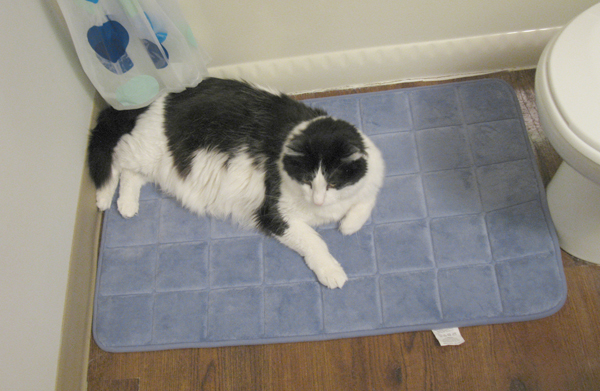
As I wrote in an article last month, Cammie has progressed a long way since first she came to live with me. It made me think about how ‘difficult’ cats are sometimes stigmatised. I should write that I don’t think there are such things as ‘difficult’ cats. People who want to adopt an ‘easy’ cat often refer to those they don’t want as ‘difficult’. The terms mean simply the difference between a cat who does what the adopter wants and one who does not, or who requires a great deal of time and patience (on the human’s part) to achieve this end.
There are certainly a goodly number of cats who are not easy. Some are unsocialised, having never been associated with people, or have not been for a long time. There are some cats who are downright feral, characterised by an rather an extreme lack of socialisation. Perhaps they were born in the woods, or a dumpster in a back alley. Perhaps they have known nothing but cruelty from humans. But these are not ‘difficult’ cats.
I came to this understanding while pondering how Cammie and I have become friends. I simply ignored her. Well, that isn’t true. I did not press her. When I walked into a room in which she was lying or sitting (or, in the early days, crouching or lurking), I would talk to her, tell her how good she looked, and generally conversed about anything that was on my mind. She grew accustomed to the sound of my voice, to my presence. The important thing was that I let her set the pace of our acquaintance.
To be fair, I had an advantage over many people who want a cat. Cammie came to me to foster. I didn’t want another pet to play with, lie on my lap, sleep next to me, and be companionable. I wanted Cammie to reach the stage at which she would be those things, but I did not bring her home expecting or wanting her to be my friend then and there. People who adopt cats, as I have mentioned before, don’t want to wait six months just to be able to stroke the animal’s head. That is entirely reasonable. But I could wait. That, I think, is the secret to winning over a cat who is, shall we say, less than easy.
In their relations with humans, animals react. Dogs and cats and other domesticated creatures excepted, the beasts of the world do not normally amble over to a person upon first spying them. They stay away. In nature, that’s how they survive. A distrustful cat returns to that tactic. So, we must act friendly, gentle, calm, welcoming. Any attempt to rush things will be viewed as hostility, regardless of the intent. Give a suspicious cat time, give her room to hide or move away if she wants to, give her your patience, and in most cases I believe you will be rewarded not just with attention but affection.

This is how I became friends with Cammie. I continue to advance our relationship. She dislikes being picked up, but tolerates it. So now I hold her at the kitchen window, to which the beasts do not usually have access. She is distracted by the different prospect; meanwhile, I support her rear legs with my hand - she has not let me touch her rear legs before. Bit by bit… When you think of it, the best way to befriend a cat thought to be difficult is to do little yourself, and let the cat do the work, slowly building up her trust. Thus, becoming a ‘difficult’ cat’s pal is rather quite easy.
I think of this when I read of rescue-groups hoping to find homes for cats who are less likely to be adopted than others. Usually, it is a matter of shyness or distrust, often both. Among the blogs I read, Feral Cat Behavior, Random Felines and Daily Dose of Dogs are authored by rescuers or foster-guardians. They all have or have had cats who fall into this category. The rescue-group to which I belong, the Lethbridge PAW Society, in southern Alberta, certainly has some little creatures who need homes with patient people.
I can tell you that though I care for all my cats, no relationship brings me the sense of achievement more than does that I have made with Cammie. When I am at the computer in the bedroom, the princess will jump onto the bed, come over for a stroke or two, then lie down and snooze. She doesn’t have to be near me (and many’s the time she isn’t!) but she frequently chooses to lie beside me, or even on me. I think to myself, in a thoroughly boastful way, “I helped make this. I was able to help her trust.” There is no feeling like it. If you are reading this and thinking of bringing a cat into your home, consider the shy ones, the mistrustful ones and, yes, even the so-called ‘difficult’ ones. A cat who trusts easily will trust anyone; a cat who is afraid and whom you win over, will trust you.